Choosing between solar panels often begins with one practical question: how to tell if a solar panel is monocrystalline or polycrystalline. The answer affects appearance, efficiency expectations, available roof space, and sometimes the system’s long-term value. Yet a quick visual check can mislead. Panel color, frame design, and branding vary across manufacturers and production years.
The International Energy Agency Photovoltaic Power Systems Programme reported that global photovoltaic capacity exceeded 1.6 terawatts by the end of 2023. Its Trends in Photovoltaic Applications 2024 report also confirms that crystalline-silicon technology remains the dominant foundation of today’s market. The International Technology Roadmap for Photovoltaic, or ITRPV, continues to track the industry’s movement toward higher-efficiency silicon cells and larger wafer formats. These trends make identification useful, especially when comparing older rooftop modules with newer products.
Look closely at the cell pattern. Monocrystalline panels usually show uniform, dark cells with clipped corners. Polycrystalline panels often display blue, mottled cells with more visible crystal variation. That clue helps.
Not proof.
A product label, datasheet, or manufacturer serial-number search provides stronger evidence. In field inspections, glare, dust, aging, and low-resolution photographs can hide important details. I have found that relying on color alone creates unnecessary mistakes, particularly under cloudy daylight. This guide explains the physical signs, label information, and performance clues that can separate the two technologies. It also addresses cases where appearance is insufficient, because accurate identification should come from evidence rather than assumption.
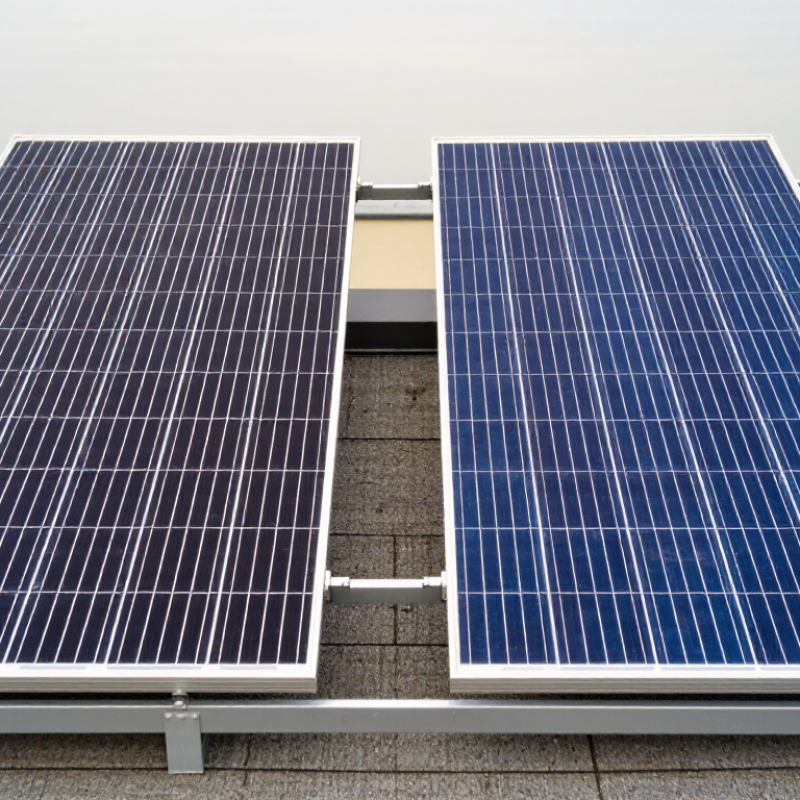
Identifying the cell structure starts with the panel’s front surface. Monocrystalline cells usually appear deep black, with clean, rounded corners. Their silicon wafers come from single-crystal ingots. Polycrystalline cells often look blue, with visible grain-like fragments and square corners. Their wafers form from multiple silicon crystals. Look closely under daylight, not strong glare. The pattern can be subtle.
The IEA PVPS Trends 2024 report states that crystalline silicon represented about 98% of global photovoltaic module production in 2023. This makes cell identification useful, but appearance alone is not proof. Anti-reflective coatings can change the color. Modern manufacturing also reduces the visual difference. Fraunhofer ISE’s Photovoltaics Report 2024 places many commercial crystalline-silicon modules near the 20–23% efficiency range. Efficiency, however, does not reliably reveal mono or poly construction. Check the rear label, datasheet, or manufacturer’s electrical specification when accuracy matters.
Tip: Inspect several cells, not one. Mono cells show consistent dark surfaces and rounded corners. Poly cells may show blue mosaic patterns. Take a clear photograph first. Dust can mislead you. So can reflections. If the label is missing, your conclusion should remain cautious. A visual guess is not a certification.
When identifying a solar panel, start with its color under natural daylight. Monocrystalline panels usually appear deep black or dark charcoal. Their cells often look smooth and evenly shaded. Polycrystalline panels commonly show blue tones, sometimes with lighter, cloudy crystal fragments. The difference is noticeable.
Look closely at the cell shape. Monocrystalline cells are cut from round silicon ingots, so their corners are often clipped. Small gaps may appear between cells. Polycrystalline cells are usually more square, with straighter edges and a fuller rectangular pattern. Run your eyes across the surface, not just one corner. Reflection can hide important details.
Surface texture offers another useful clue. Polycrystalline cells may display irregular, mosaic-like patterns, almost like crushed blue glass beneath the coating. Monocrystalline surfaces usually look more uniform. Still, this shortcut is imperfect. Anti-reflective coatings, dust, age, and sunlight direction can change the appearance. A black frame does not prove the cells are monocrystalline, either. I would never rely on color alone. Check the product label, technical sheet, or installation records when accuracy matters. Some modern panels also use designs that blur the traditional visual differences. Take a clear close-up photo, compare several cells, and treat your first impression as a working guess, not final proof.
| Visual or Technical Dimension | Monocrystalline Panel | Polycrystalline Panel | How Reliable Is This Clue? |
|---|---|---|---|
| Typical panel color | Usually deep black, dark gray, or black with a subtle blue tone. | Often medium to dark blue, sometimes with a visibly varied or mottled appearance. | Moderate. Glass coatings, lighting, viewing angle, and frame color can change the apparent color. |
| Cell shape | Cells commonly have clipped corners, producing an octagonal outline with small gaps between cells. | Cells are commonly square or nearly square, with fewer visible clipped-corner gaps. | Useful for older and traditional designs, but less conclusive because modern cell formats vary. |
| Surface pattern | Usually appears more uniform, with a consistent dark surface and regular cell layout. | Often shows a distinctive blue, grain-like, or cloudy crystal pattern caused by multiple silicon crystals. | Moderate to high when the pattern is clearly visible and the panel has a conventional design. |
| Silicon crystal structure | Each cell is made from a single continuous silicon crystal structure. | Each cell is made from many silicon crystal fragments or grains joined together. | Not normally verifiable from appearance alone; it is a manufacturing characteristic. |
| Cell corner appearance | Traditional cells show four clipped corners, which may reveal small diamond-shaped gaps in the grid. | Traditional cells generally fill the grid more completely because their corners are usually not clipped. | Helpful, but newer wafer and cell-cutting technologies can make the distinction less obvious. |
| Cell color consistency | Cells usually have a relatively even color across the panel, especially in all-black designs. | Individual cells may show more tonal variation because of the different crystal grains. | Moderate. Anti-reflective coatings can make either technology look more uniform. |
| Typical space efficiency | Generally higher power output per unit of panel area, making it suitable where roof space is limited. | Historically lower power density than monocrystalline panels, although the difference depends on the specific design. | Low as a visual clue; rated power and dimensions must be checked on the specification label. |
| Temperature performance | Performance decreases as temperature rises, with the exact effect determined by the panel’s temperature coefficient. | Also experiences temperature-related power loss; the actual result depends on the panel specification. | Not identifiable by appearance. Compare the temperature coefficient in the datasheet. |
| Best identification method | Confirm the cell technology in the product datasheet, nameplate, installation documents, or electrical specifications. | Confirm the cell technology using the same documentation rather than relying only on color or pattern. | High. Documentation is more dependable than visual inspection. |
To identify whether a solar panel is monocrystalline or polycrystalline, start with its nameplate. Look for terms such as “monocrystalline silicon,” “polycrystalline silicon,” or “mono-Si.” The label may also list the cell count, rated power, voltage, and current. These numbers help confirm the product, but they do not always reveal the crystal type.
The datasheet is usually more reliable than the panel’s appearance. Check the “cell type,” “technology,” or “materials” section. A mono panel commonly uses monocrystalline silicon cells, while a poly panel uses polycrystalline silicon cells. Terms such as PERC or TOPCon describe cell structures or production technologies, not necessarily the crystal category. Read the wording carefully. Marketing descriptions can be vague.
The model number may include a useful code, but never rely on it alone. Compare the model number across the label, datasheet, and product specification sheet. The documents should show matching power ratings and electrical values. A black surface often suggests mono cells, while a blue, speckled surface may suggest poly cells. Appearance is only a clue. Lighting can mislead you. In my experience, older panels sometimes have incomplete labels, and copied online listings may contain errors. When the documents disagree, request a signed technical sheet or a written clarification from the supplier. Do not guess from color alone.
Product labels and datasheets usually provide the clearest clues. Monocrystalline modules commonly show higher efficiency and a lower power-loss coefficient with temperature, while polycrystalline modules typically show slightly lower efficiency and a higher temperature coefficient. Actual specifications vary by module design and production year.
Typical representative values: module efficiency is shown as a percentage, while temperature coefficient shows the approximate power loss per 1°C increase above the rated test temperature. For confirmation, check the datasheet for “cell type,” “module efficiency,” and “Pmax temperature coefficient.”
Electrical ratings can support panel identification, but they cannot prove cell type alone. Read the nameplate beside the junction box. Compare maximum power (Pmax), voltage at maximum power (Vmp), current at maximum power (Imp), open-circuit voltage (Voc), and short-circuit current (Isc). Monocrystalline panels often deliver higher power from the same physical area. However, panel size and cell format can distort this comparison.
The International Technology Roadmap for Photovoltaics reported that monocrystalline wafers exceeded 98% of global wafer production in 2023. This explains why many newer panels show high Pmax values and compact dimensions. The Fraunhofer Institute’s Photovoltaics Report 2024 placed common commercial crystalline-silicon module efficiencies around 20% to 23%.
Still, efficiency does not identify mono or poly by itself. A high-efficiency polycrystalline panel may outperform an older monocrystalline model. Ratings also change under Standard Test Conditions, using 1,000 W/m² irradiance and a 25°C cell temperature. Real rooftops are less cooperative.
Tips: Measure the panel’s physical dimensions, then calculate Pmax divided by area. Compare the result with the datasheet efficiency. Check the cell appearance too: mono cells usually look darker and more uniform, while poly cells often show blue, mosaic-like patterns. Use electrical data as supporting evidence, not a final verdict. I have seen field labels fade, and replacement junction boxes create confusion. Recheck the original datasheet when possible.
The most reliable way to identify a solar panel is to check the manufacturer’s information. Start with the model number on the rear label or frame. Enter that exact code on the manufacturer’s official website. Look for a technical datasheet, product page, or installation manual. These documents often state “monocrystalline” or “polycrystalline” under cell technology.
Read carefully.
Do not rely only on color or cell patterns. Dark, uniform cells may suggest monocrystalline construction, while blue, varied cells may suggest polycrystalline construction. However, coatings and lighting can make both types look similar. The model code provides stronger evidence. Compare the panel’s wattage, dimensions, cell count, and electrical ratings with the published document. A mismatch may indicate a different revision or an incorrect listing.
Look for deep black or dark charcoal cells with smooth, consistent shading. Cell corners often appear clipped or rounded. Inspect several cells. One cell is not enough.
Polycrystalline panels often show blue surfaces with cloudy, mosaic-like crystal patterns. Their cells usually have straighter, squarer corners. The texture can resemble crushed blue glass.
No. Anti-reflective coatings, dust, age, and reflections can change the color. A black panel may suggest monocrystalline construction, but it is not proof.
Read the rear nameplate, datasheet, or electrical specification. Look for terms such as “monocrystalline silicon,” “polycrystalline silicon,” or “mono-Si.” Documents are usually more reliable than appearance.
Not reliably. Many commercial crystalline-silicon panels operate near the 20–23% efficiency range. Efficiency alone cannot confirm the crystal structure.
Check the model number, rated power, voltage, current, and stated cell type. Compare these details with the datasheet. Matching values strengthen the identification.
Yes. Modern designs and coatings can reduce the traditional difference between black and blue surfaces. Your first impression may be wrong.
Take a clear close-up photograph in natural daylight. Compare several cells and check installation records. If evidence conflicts, keep the conclusion cautious and request written clarification. Do not pretend certainty.
Learning how to tell if a solar panel is monocrystalline or polycrystalline starts with examining the solar cells. Monocrystalline panels usually contain dark, uniform cells with rounded or clipped corners, while polycrystalline panels often have a blue, speckled appearance and more visibly varied crystal patterns. The panel’s color, cell shape, and surface texture can provide useful clues, although lighting and protective glass may affect what you see.
For a more reliable identification, read the label, datasheet, or product specifications for terms such as “monocrystalline” or “polycrystalline.” Electrical ratings, including power output, voltage, current, and efficiency, can support your assessment, but they do not always confirm the cell type by themselves. When visual details and specifications are unclear, checking the manufacturer’s official documentation or contacting the supplier is the best way to verify the panel’s construction accurately.
Ran Solar