The solar energy industry continues to evolve. Among its key innovations are N-type and P-type solar cells. As renewable energy grows in importance, understanding these differences is crucial. Jack Greene, a leading expert in solar technology, stated, “Understanding what is the difference between N-type and P-type solar cells can influence energy efficiency and costs.”
N-type cells utilize phosphorus to create a surplus of electrons. This makes them more efficient in low-light conditions. In contrast, P-type cells rely on boron, leading to a deficit of electrons. This fundamental difference affects their performance, lifespan, and overall energy output. Some studies indicate that N-type cells can have a higher efficiency rate compared to their P-type counterparts. However, the production of N-type cells can be more complex and costly.
Exploring what is the difference between N-type and P-type solar cells opens doors to better technology. Awareness of these distinctions will enable homeowners and businesses to make informed choices. As the market expands, understanding these differences will be increasingly important for optimizing solar energy use and sustainability.
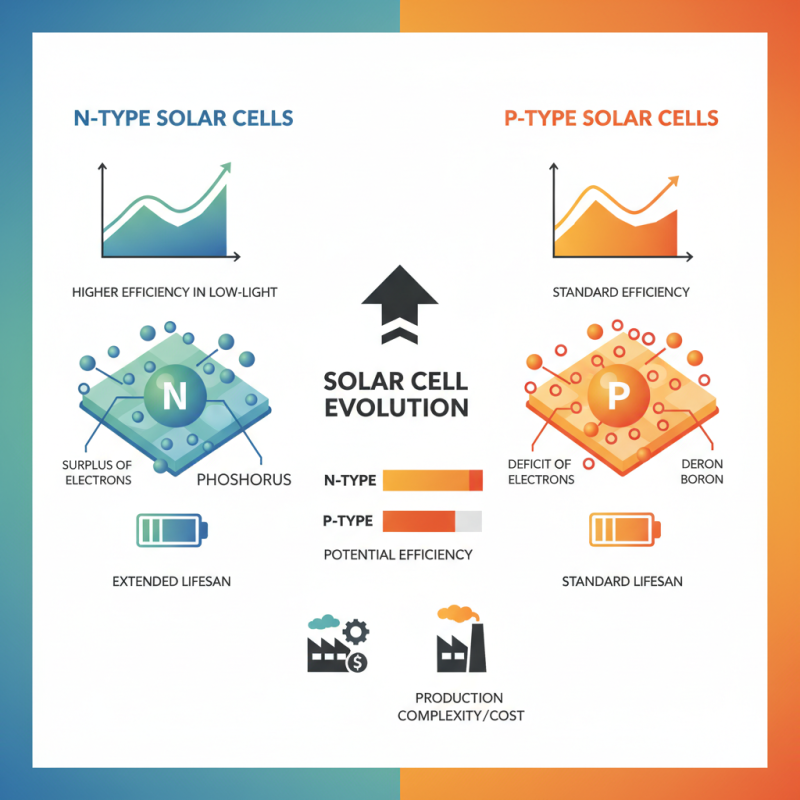
When it comes to solar cells, the choice between N-type and P-type is crucial. The distinction often lies in the doping materials utilized during their manufacturing process.
N-type solar cells incorporate phosphorus as the doping agent. This introduces extra electrons into the silicon crystal structure, enhancing its conductivity. Ultimately, this leads to improved efficiency and performance in certain applications.
On the other hand, P-type solar cells typically use boron for doping.
Boron creates "holes" or vacancies in the silicon lattice, which allows for positive charge carriers. The difference in carrier concentration can significantly influence the solar cell's behavior. However, these cells are often more prone to light-induced degradation. This factor raises concerns over long-term performance.
To choose the right type of solar cell, it is essential to consider these differences carefully. The choice influences the overall efficiency and reliability of solar panels. Each type presents its own set of strengths and weaknesses. Understanding these nuances can lead to a better-informed decision.
The charge carrier dynamics significantly differ between N-type and P-type solar cells. N-type cells use phosphorus-doped silicon. This creates extra electrons, enhancing electrical conductivity. Electrons are the primary charge carriers, moving freely and contributing to higher efficiency.
On the other hand, P-type cells utilize boron-doped silicon. This doping creates "holes" in the silicon lattice. These holes act as positive charge carriers. In these cells, holes move towards the negatively charged regions, generating power. Although P-type cells are reliable, their efficiency can sometimes be lower due to recombination loss.
In practice, N-type solar cells exhibit less susceptibility to light-induced degradation. This is beneficial in real-world conditions where exposure to sunlight is constant. However, they often require more complex manufacturing processes. P-type cells remain popular because of their simpler production, despite their limitations. Balancing efficiency with manufacturing feasibility remains a challenge in solar technology.
| Characteristic | N-type Solar Cells | P-type Solar Cells |
|---|---|---|
| Doping Element | Phosphorus | Boron |
| Charge Carrier Majority | Electrons | Holes |
| Temperature Coefficient | Better performance in high temperature | Lower performance in high temperature |
| Light-induced Degradation | Less prone | More prone |
| Longevity | Higher durability | Generally lower durability |
| Efficiency | Typically higher efficiency | Typically lower efficiency |
| Cost of Production | Generally higher due to materials | Generally lower |
| Environmental Impact | Less toxic materials | More toxic materials |
| Market Adoption | Growing popularity | Currently dominant in the market |
| Temperature Stability | More stable under varying conditions | Less stable under varying conditions |
N-type and P-type solar cells offer distinct efficiencies and benefits. Recent industry reports indicate that N-type cells can achieve efficiencies of up to 26.7%, compared to around 22% for P-type cells. This advantage is attributed to the improved light absorption and reduced recombination losses in N-type designs. Notably, N-type cells often maintain their performance better under high temperatures and shading conditions.
The materials used in these solar cells also contribute to their efficiency. N-type cells utilize higher purity silicon, which enhances electron mobility. In contrast, P-type cells may suffer from defects that impact performance over time. Furthermore, studies show that N-type technology can potentially lower the degradation rate to about 0.3% annually, compared to 0.6% for P-type cells. This implies a longer lifespan for N-type modules.
Tip: When choosing between N-type and P-type solar cells, consider long-term efficiency and performance stability. Look for specific panel certifications that validate these claims. It’s important to review user testimonials to gauge real-world experiences. Even the most efficient technology may not be the best fit for every application, so weigh the pros and cons carefully.
Temperature performance plays a vital role in the efficiency of solar cells. N-type and P-type solar cells react differently to temperature fluctuations. Understanding these differences can help optimize energy production.
N-type solar cells generally exhibit better performance in high temperatures. Their structure allows them to maintain efficiency, even when the heat rises. This means they can generate more power in warm environments. On the other hand, P-type cells suffer a notable drop in efficiency as temperatures climb.
The manufacturing process for N-type and P-type solar cells differs significantly, impacting their efficiency and performance. N-type solar cells utilize phosphorus as a dopant, while P-type cells use boron. These choices affect the movement of electrons and holes within the cell. The way these materials interact with light also varies, leading to different absorption rates.
In terms of production, N-type cells generally require a more complex fabrication process. This often involves additional steps in doping and cleaning. Higher purity silicon is a must for N-type cells, raising costs. P-type cells, on the other hand, are simpler to produce but may suffer from efficiency losses due to recombination of charge carriers. The advantages and challenges in each method warrant careful evaluation.
Understanding these processes helps assess the performance outputs of solar panels. Each type has its strengths and weaknesses. N-type cells can offer higher efficiency and longevity but at a higher initial cost. P-type cells might suit budget-conscious consumers, yet they could compromise long-term returns on investment.
: N-type cells use phosphorus and enhance conductivity. P-type cells use boron, creating holes for positive charge carriers.
N-type cells have electrons as primary carriers. P-type cells have holes. This affects their efficiency and performance.
Often, yes. N-type cells exhibit higher efficiency and less degradation in sunlight. However, manufacturing is more complex.
They require higher purity silicon and more complex processes. This can increase production costs and time.
P-type cells are easier to produce and less expensive. They may suit budget-conscious consumers despite long-term efficiency losses.
Doping with phosphorus increases electron concentration in N-type cells. Boron in P-type cells allows holes, influencing overall power generation.
They can suffer from higher light-induced degradation, raising concerns about their long-term performance and reliability.
It significantly influences efficiency and longevity. Understanding their strengths and weaknesses can help make informed decisions.
The article "China Top 10 Differences Between N-type and P-type Solar Cells" explores the key distinctions between N-type and P-type solar cells. One of the primary factors is the doping materials used: N-type cells are doped with materials like phosphorus, while P-type cells utilize materials such as boron. This difference in doping leads to varying charge carrier dynamics, with N-type cells generally exhibiting superior electron mobility.
Efficiency comparisons reveal that N-type solar cells often perform better in real-world conditions, particularly under high temperatures. Additionally, the manufacturing processes for both types show distinct approaches, affecting cost and scalability. Overall, understanding what is the difference between N-type and P-type solar cells is crucial for optimizing solar technology and enhancing energy conversion efficiency.

Ran Solar